
- In this article
There’s no universal answer to how often a Perth office should be cleaned — and anyone who quotes you a flat rate without seeing your facility is guessing. The right frequency depends on five things: how many people work in the space, how much foot traffic comes through, what industry you’re in, how visible cleanliness is to your business, and what building you’re in. Most Perth offices fall into one of three rhythms, and most know intuitively which one fits them.
What follows is the actual framework we use when quoting Perth offices — based on what we see working across hundreds of commercial sites. No fluff, no upsell. Just the practical answer.
01
Why frequency matters more than you think
Cleaning frequency is the single biggest cost driver in a commercial cleaning contract — but it’s also the single biggest determinant of whether the cleaning actually works. Too infrequent and dirt accumulates faster than weekly visits can address; the office never feels properly clean. Too frequent and you’re paying for cleaning that doesn’t change the visible state of the space.
The trap most Perth offices fall into is choosing frequency based on budget rather than on actual needs. We’ve seen 40-person offices on fortnightly cleaning contracts where the team has visibly given up on cleanliness because the cleaners can’t keep up. We’ve also seen 8-person offices on daily contracts where the cleaners are essentially dusting clean surfaces every night.
- Quick test
How to know if your frequency is right
If your team is buying their own desk wipes or the bathrooms are visibly off by mid-week, you need more frequency. If the cleaners regularly leave notes saying "nothing to do tonight," you can probably go less often.
02
The three frequency patterns that work
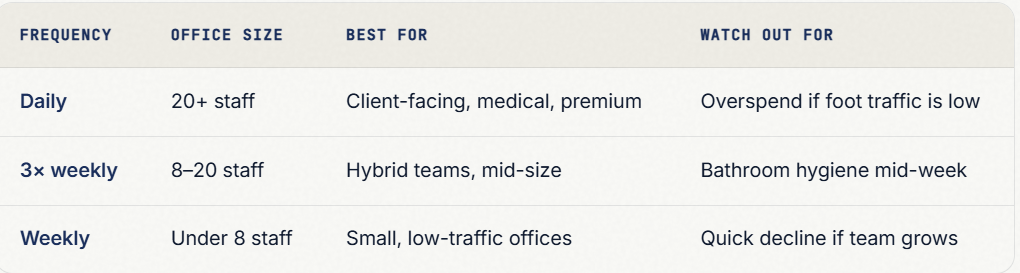
Across the Perth offices we service, roughly 90% fall into one of three patterns: daily after-hours, three-times-weekly, or weekly. Each suits different business types, and each has tradeoffs.
Daily after-hours cleaning
Cleaners arrive after staff have left — typically between 5pm and 11pm, or before 7am — and complete a full clean every day. This is the most expensive option but produces a consistently clean office that never has visibly accumulated dirt.
- Daily cleaning works best for:
Offices with 20+ staff (foot traffic creates daily mess faster than weekly cleaning can address)
Client-facing offices where visitors are common — law firms, accounting practices, sales offices
Medical, dental and allied health (clinical-grade cleaning, infection control)
Offices where breakfast and lunch are eaten at desks or in shared kitchens
Tenancies in premium CBD towers where cleanliness expectations are higher
Three-times-weekly (Mon/Wed/Fri pattern)
The “every-other-business-day” rhythm covers all main areas three times a week, typically on a Monday-Wednesday-Friday pattern. Bathrooms still get attention every visit (this is non-negotiable for offices with shared facilities). Carpets, dusting, and general surfaces rotate.
- Three-times-weekly works best for:
Offices with 8–20 staff where daily isn't justified
Lower-traffic offices that aren't client-facing
Hybrid-work offices where in-office days are 3-4 per week
Smaller professional services firms
Weekly cleaning
One full thorough clean per week — usually Friday evening so the office is fresh for Monday. This is the most cost-effective option but requires that your team is reasonably tidy day-to-day, and isn’t suitable for offices with high foot traffic.
- Weekly cleaning works best for:
Offices with fewer than 8 staff
Quiet, low-traffic professional offices
Remote-first companies with small physical offices
Tech and creative offices where the team self-manages tidiness
03
Industry-specific minimums
ome industries have higher cleaning floors that override the general frequency framework. These aren’t suggestions — they’re either regulatory or strongly expected by clients and staff.
Medical and allied health require daily clinical-grade cleaning at minimum. Some specialties (dental, surgical) need more frequent. Documented protocols are typically expected for audit purposes.
Childcare and education have specific cleaning requirements set by regulators. WWC-cleared staff are required, and certain surfaces must be cleaned multiple times per day. See our childcare cleaning page for full requirements.
Food service offices and break rooms attached to hospitality businesses follow food safety standards that often require more frequent cleaning of kitchen-adjacent surfaces.
Gym and fitness offices attached to fitness facilities benefit from daily cleaning regardless of office size — sweat, equipment use and changing rooms create demands that office-only frequency models don’t address.
The right cleaning frequency is the one where your team stops noticing whether the office has been cleaned — because it's always clean.
Our quoting principle for Perth offices
04
Five signs you need more frequent cleaning
If you’re not sure whether your current schedule is enough, look for these signals over a typical week:
Staff are buying their own cleaning supplies. If your team is keeping disinfectant wipes at their desks, the gap between cleans is too long.
Bathrooms degrade visibly by mid-week. Toilet paper running out, hand towel dispensers empty, soap dispensers not refilled — these are frequency issues.
Bins overflow before the next visit. Particularly the kitchen bin. If it's full and starting to smell two days into the cleaning cycle, the cycle is too long.
Clients comment on the office. Not in a positive way. If visitors notice dust, smudged glass, or general untidiness, your competitors won't.
The cleaners say so. A good cleaning crew will tell you if they're not keeping up. Listen to them — they see the state of the office before you do.
05
Three signs you could reduce frequency
The other direction is just as important — cleaning more than you need is wasted money that could be reallocated to deeper periodic cleans or better service:
The cleaners regularly say there's "nothing to do." An honest crew will mention this. If it's coming up frequently, your office probably doesn't need the frequency it's on.
Foot traffic has dropped permanently. Post-pandemic hybrid working means many offices need 40–60% less cleaning than they did in 2019. Re-quote based on current usage, not historical assumptions.
You've moved to a smaller or more efficient space. Less square footage, fewer touch points, less cleaning needed. Quote should reflect the move.
- Tailored quote
Not sure what frequency you need? We'll quote properly.
Tell us about your Perth office and we’ll come back within 24 hours with a tailored frequency recommendation and itemised quote — no high-pressure sales call.
06
Don't forget periodic deeper cleans
Whatever your weekly rhythm, there are tasks that don’t fit a daily or weekly schedule. Carpet steam cleaning, high-level dusting, deep kitchen cleans, window cleaning, and upholstery cleaning belong on a quarterly or six-monthly schedule depending on use.
The mistake we see most often is offices paying for daily cleaning and assuming it includes deep work. It doesn’t. Daily cleaning maintains an already-clean office; periodic cleaning resets the baseline. Both are needed. Our office cleaning page breaks down exactly what’s included in each.
- The right way to think about it
Frequency × Depth = Total cleaning hours
A good quote includes both. Weekly cleaning with quarterly deep clean might give you a better result than daily light cleaning with no deep work — at lower total cost. Ask your cleaner to show you both numbers.
07
How to actually decide
If you’re choosing a frequency from scratch — for a new office, after a move, or because you’re reassessing — the simplest approach is:
Count your staff and visitors. Average daily occupancy, not maximum.
Identify the messiest pinch-points. Usually shared kitchen, bathrooms, and reception.
Match to the table above. Use it as a starting point, not a final answer.
Get a site assessment from at least one cleaner. Quotes done without a site visit are guesses. A 15-minute walkthrough costs nothing and produces accurate quotes.
Plan for periodic deep cleans separately. Quarterly carpets, six-monthly windows, annual high-level dusting. Build them into the contract.
The right answer is usually obvious once someone professional walks your space. If you’d like that walkthrough in Perth, request a free assessment — we’ll come out, look at the space, and tell you honestly what we recommend. No obligation, no upsell.
- Written by

The Commercial Cleaning Perth operations team
This article was written by the people who run the cleaning contracts — site supervisors, account managers, and quality leads who quote and operate commercial cleaning across Perth metro every week. Practical content, not marketing copy.